
Affiliate marketing and cross-border B2B payouts are built on trust. Digital iGaming and e-commerce operators depend on affiliates to bring in traffic, while affiliates depend on operators to pay commissions on time.
When international affiliate payouts are delayed, the issue goes beyond admin; late payments can affect cash flow, weaken trust, and influence where affiliates choose to send future traffic.
In this article, we explain why affiliate payout speed matters and how stablecoin payment infrastructure can make global affiliate payouts easier to manage.
What is an affiliate payout? An affiliate payout is the commission payment transferred from an operator or network to an affiliate marketer for driving traffic or conversions. Optimising payout speed via modern digital payment infrastructure minimises cash flow constraints, reduces merchant churn, and fosters long-term affiliate trust.
Affiliates are performance partners, meaning that many spend money upfront on content, SEO, PPC, media buying, comparison sites, and traffic before they earn their commission. As a result, when affiliate payouts are delayed, this can put pressure on their cash flow, especially for smaller partners or affiliates working across several markets.
For affiliates, payout speed is part of the business relationship; if commissions arrive late, it doesn’t matter why the delay is happening, even if it comes from the banking system. The result is the same: the operator can seem less reliable.
Fast, predictable affiliate payouts can help operators:
The main issue with traditional bank payouts isn’t always SWIFT itself. SWIFT is just the system banks use to send secure payment messages, but after that message is sent, the payment still depends on local banks and other payment systems.
SWIFT reports that:
This underlines the gap between a payment reaching the bank and the money reaching the person or business waiting for it.
Essentially, payments may be slowed down by:
This becomes harder to manage when operators pay affiliates in many countries, since each market may involve different banks, currencies, processing times, and rules around payment.
This is where a provider like Payhound can help. Instead of relying only on traditional bank rails for every international affiliate payment, operators can use crypto and stablecoin payment infrastructure.
Speed isn’t the only issue with traditional cross-border payouts. Costs can also build up during the payment process, especially when operators pay many affiliates in different countries.
Although affiliate payouts aren’t remittances, World Bank data gives useful context around how international payments can carry high costs. In Q3 2025:
Even though this data isn’t directly about affiliate payouts, it shows that smaller international payments can end up becoming very expensive.
For affiliate teams, the cost can come through:
Different banks may also use different payment references, making reconciliation harder for finance teams.
Payhound can help reduce this friction by giving operators a more direct way to manage international affiliate payouts. Thanks to clear payment records and support for crypto and stablecoin payments, finance teams can spend less time chasing payment references and more time managing the wider affiliate programme.
The main difference between traditional bank payouts and blockchain payouts is how they work in practice. Bank payouts depend on banking hours, local processing times, and other factors, while stablecoin payouts use blockchain networks, meaning they can run 24/7 and make 24-hour affiliate payout models more realistic.
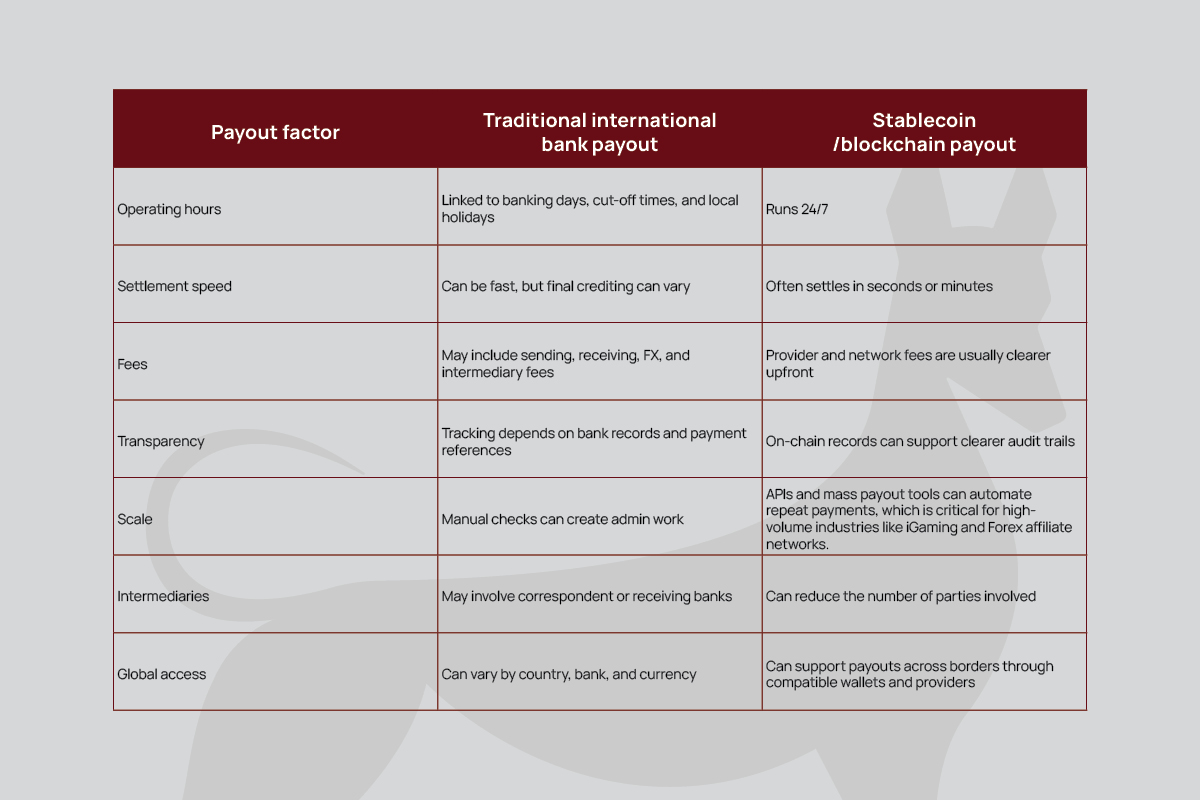
For affiliate teams, the main benefit of blockchain payments is simple: they make international payments easier to manage because operators can use payment networks that run all day, every day.
This can help operators improve:
Stablecoins especially are becoming a popular option because they bring together blockchain speed and price stability. Visa’s Onchain Analytics Dashboard shows that stablecoins are already moving at a large scale. Over the past 12 months:
EY-Parthenon’s 2025 survey also shows growing business interest, finding that 13% of corporates and financial institutions had already used stablecoins, while 54% of non-users expected to start within the next six to 12 months. Among users, 41% reported cost savings of at least 10%.
For finance teams, stablecoins can help reduce one of the main concerns around crypto payments: price movement. Stablecoins are designed to follow the value of a fiat currency, often USD or EUR, using major market tokens like USDC and USDT. This means operators don’t need to hold assets that can rise or fall sharply in value. Unlike unbacked crypto assets, fully reserved stablecoins maintain a 1:1 peg backed by liquid cash and short-term US Treasuries, drastically minimising balance sheet volatility for corporate treasuries.
The process can work as follows:
This means operators can use blockchain payment infrastructure without changing their whole treasury approach.
This is important because operators don’t need to suddenly become crypto traders to use stablecoin payouts. Payhound can support the payment process by helping operators move between fiat and stablecoins, so they can benefit from faster blockchain rails while keeping finance workflows easier to manage.
This also fits in with EY-Parthenon’s findings; 56% of corporates prefer stablecoin integration through embedded APIs in their existing treasury or payment platforms, and around 70% said they’d be more willing to use stablecoins if they were integrated into their ERP system. Therefore, it’s clear that stablecoin payouts need to work with existing systems.
Crypto payouts can be faster, but they still need proper controls. Operators need to know who they’re paying, check affiliate details, follow AML and KYC requirements, and keep payment records.
This is why regulated payment providers are so important: working under modern compliance frameworks like Europe’s MiCA (Markets in Crypto-Assets) regulation, a provider like Payhound can help operators use crypto payment rails while keeping oversight of the payment process.
This can support:
As affiliate programmes grow, affiliate payouts become harder to manage manually. A regulated payment provider can help operators keep the process cleaner.
Payhound can help operators by supporting:
For operators, the value in better payout infrastructure lies in reducing admin, making payments easier to track, and helping finance teams manage large affiliate programmes with fewer manual steps.
As affiliate programmes become more global, payment infrastructure needs to keep up. Traditional bank payouts still have a role, but operators that want faster and easier international affiliate payouts need tools built for scale.
Payhound helps operators use crypto and stablecoin payment infrastructure to support more efficient global payment operations. You can follow Payhound for more practical insights into crypto payments and the future of affiliate payment infrastructure.
Read our latest Insights

.jpg)

.jpg)






.jpg)
.jpg)





.png)
.png)
.png)
.png)

.png)

.png)
.png)
.jpg)


.png)

.png)


.png)


